
Updated: July 2026
The best survival lighter depends on the role it needs to fill. A disposable butane lighter works well as a low-cost backup, a sealed liquid-fuel lighter offers refillability and serviceable parts, and a rechargeable plasma lighter avoids carrying fuel but depends on battery power.
For an emergency kit, the most reliable approach is not to depend on one ignition method. Choose one primary lighter that matches your environment, then store a second lighter or fire-starting method as backup.
Disclosure
WEDO makes one of the products discussed in this guide. We have not laboratory-tested every third-party lighter under identical conditions. The comparison below uses current manufacturer information and practical emergency-kit criteria, with strengths and limitations listed separately.
TL;DR
A practical emergency kit should include one primary lighter and at least one backup ignition method.
Choose liquid fuel for serviceability, plasma for fuel-free rechargeable use, a sealed design for moisture protection, or a disposable butane lighter for inexpensive redundancy. No single option is best in every condition.
Table of Contents
- Quick Comparison of Survival Lighters
- How We Compared the Options
- Five Survival Lighter Options
- Liquid Fuel vs. Electric Survival Lighters
- How to Build a More Reliable Fire-Starting Kit
- How to Maintain a Survival Lighter
- Which Survival Lighter Should You Choose?
- Final Thoughts
- Frequently Asked Questions
Quick Comparison of Survival Lighters
A “survival lighter” is not a separate ignition technology. It is a lighter chosen for emergency storage, outdoor backup, camping, vehicle kits, or situations where dependable fire-starting matters.
If you are still comparing the basic fuel and ignition categories, start with our guide to the types of lighters. The table below focuses on how five practical options fit into an emergency kit.
| Option | Fuel or Power | Best For | Main Strength | Main Limitation |
|---|---|---|---|---|
| WEDO Medium Classic | Liquid lighter fuel | Serviceable brass carry | Waterproof sealed insert, replaceable parts, and solid brass construction | Heavier; fuel can evaporate and requires maintenance |
| SOL Fire Lite Fuel-Free | Rechargeable battery | Compact rechargeable backup | Waterproof case, dual arcs, LED light, no fuel | Depends on battery charge and direct arc contact |
| Exotac titanLIGHT | Liquid lighter fuel | Sealed liquid-fuel storage | O-ring sealing and refillable construction | Higher cost and regular liquid-fuel maintenance |
| BIC Maxi Pocket Lighter | Isobutane | Budget backup and redundancy | Inexpensive, lightweight, widely available | Disposable, not sealed, and not user-serviceable |
| UST TekFire PRO | Rechargeable battery | Multi-purpose rechargeable backup | Flameless arc plus ParaTinder cord | Battery-dependent and requires contact with suitable tinder |
How We Compared the Options
This guide does not claim that all five lighters were tested under identical laboratory conditions. Instead, the comparison uses current manufacturer specifications and the practical questions that matter when storing an ignition tool for an emergency.
1. Fuel or Power Availability
A lighter is only useful if its fuel or battery can be replenished. Liquid fuel, butane, and USB charging each have different storage and availability requirements.
2. Weather Protection
Windproof, wind-resistant, water-resistant, sealed, and waterproof are not interchangeable terms. Manufacturer claims and test methods should be read carefully. Even when an inner chamber stays dry, exposed parts such as a flint wheel, charging port, or ignition surface may still need to be dried after submersion.
3. Serviceability
Replaceable flints, wicks, cotton, seals, and striker wheels can extend the working life of a refillable lighter. Disposable and electronic designs may require less routine maintenance but can be harder to repair.
4. Size and Weight
A lighter for a pocket has different requirements from one stored in a vehicle, emergency bag, or home kit. Weight can add durability and presence, but it also matters when every ounce in a pack is important.
5. Storage Reliability
Liquid fuel can evaporate, butane pressure changes with temperature, and batteries lose charge over time. A stored lighter must be inspected periodically rather than assumed to be ready forever.
6. Backup Value
The strongest emergency setup uses different ignition methods. A liquid-fuel lighter paired with a disposable butane lighter, waterproof matches, or a ferrocerium rod provides better redundancy than two identical tools with the same weakness.
Five Survival Lighter Options Compared
1. Best for Serviceable Brass Carry: WEDO Medium Classic

WEDO Survival Kit Pick
Medium Classic — Serviceable Brass Carry
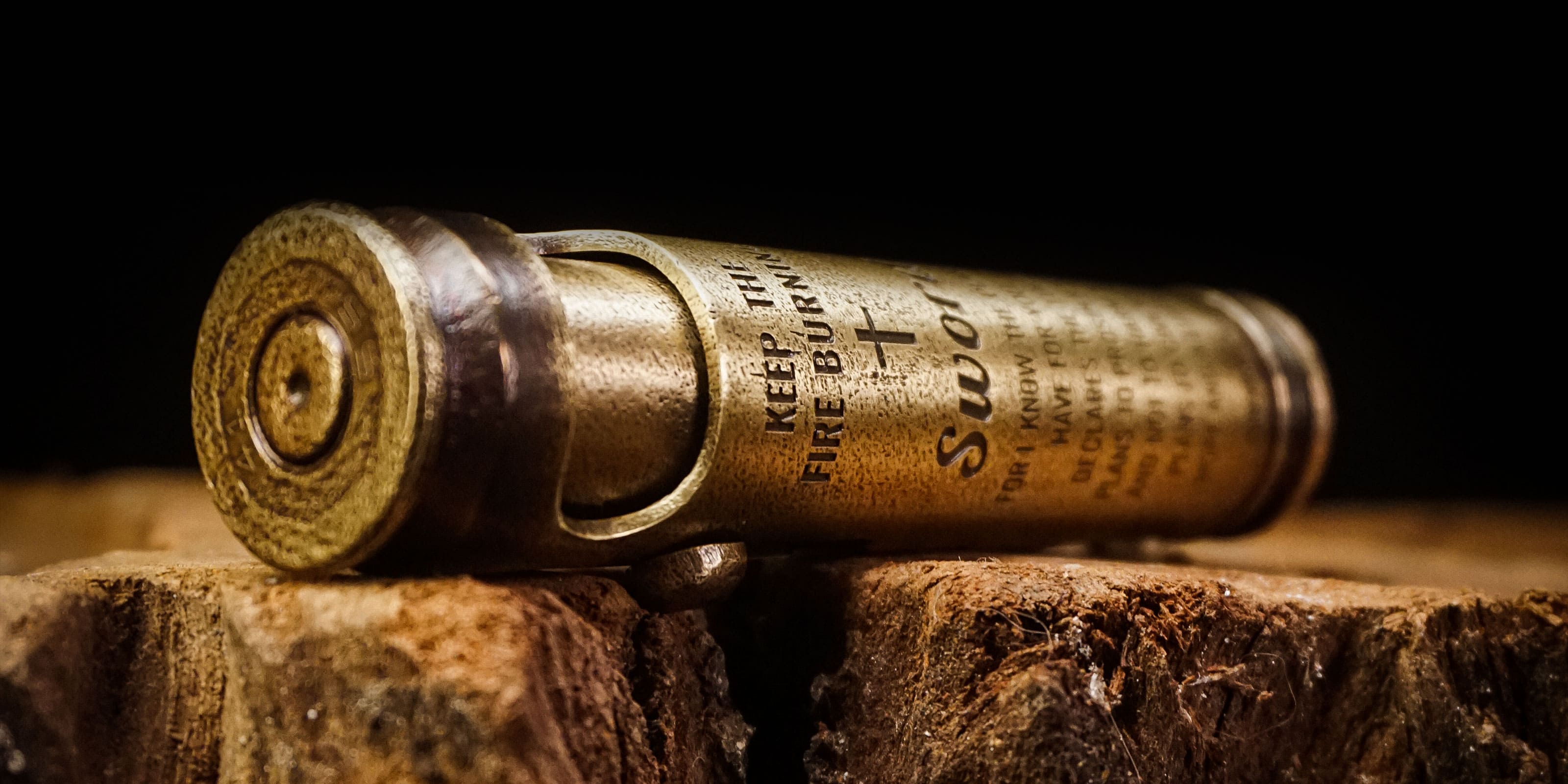
Medium Classic combines a refillable liquid-fuel wick system, real repurposed brass shell casing, mechanical bolt-action ignition, and replaceable working parts.
Choose it when repairability, solid hand feel, and long-term ownership matter more than minimum weight or zero-maintenance storage.
WEDO Medium Classic is a refillable liquid-fuel wick lighter built from a real repurposed brass shell casing. It uses a mechanical bolt-action ignition and is designed as the most balanced size in the Classic range.
The Medium model is approximately 3.23 inches tall, weighs about 3.7 oz, and includes replaceable components such as the flint wheel, flint, wick, cotton, O-ring, springs, and chain. Those serviceable parts make it useful for owners who are willing to inspect and maintain their equipment.
Its strengths are solid brass construction, mechanical handling, replaceable parts, and an O-ring-sealed insert designed to keep water out. In a WEDO in-house test, a lighter remained submerged in water for three days without water entering the inner chamber. After removal, the external flint wheel was wiped dry and the lighter ignited normally.
Its limitations still matter in an emergency kit. Medium Classic is heavier than plastic disposable lighters, ships without fuel, and standard liquid lighter fuel can evaporate naturally over time. After submersion, the exposed flint wheel should be wiped dry before ignition. Fuel level, wick position, cotton packing, flint condition, and the O-ring should also be checked before a trip or emergency season. The three-day submersion result is based on WEDO's own product test rather than a third-party IP certification.
- Best for: Users who value repairability, brass construction, and mechanical carry.
- Strength: Waterproof sealed insert, replaceable parts, and a real brass shell casing.
- Limitation: Requires liquid fuel, maintenance, and periodic inspection.
2. Best Compact Rechargeable Backup: SOL Fire Lite Fuel-Free

The SOL Fire Lite Fuel-Free Lighter is a rechargeable dual-arc plasma lighter with a watertight case, built-in LED light, and tinder-cord lanyard. SOL lists the lighter at less than 2 oz and states that its battery charges in about two hours and can light more than 100 fires per charge.
Its strongest advantage is compact fuel-free storage. The user does not need to carry butane or liquid lighter fuel, and the manufacturer describes the case as waterproof and the electric arc as windproof.
The limitation is battery dependence. A rechargeable lighter must be checked and charged periodically, especially if it stays in a vehicle or emergency bag for long periods. The arc also needs close contact with a suitable wick, tinder cord, stove contact point, or other narrow material.
- Best for: Lightweight emergency bags and rechargeable backup use.
- Strength: Waterproof case, dual arcs, LED light, and no liquid fuel.
- Limitation: Battery charge and direct-contact ignition requirements.
3. Best Sealed Liquid-Fuel Option: Exotac titanLIGHT

The Exotac titanLIGHT is a refillable liquid-fuel lighter made from aircraft-grade aluminum. Exotac describes it as waterproof and uses O-ring seals to reduce leakage and extend the interval between refills.
This makes it a useful option for someone who prefers a traditional flame and refillable wick system but wants stronger sealing than an open-top liquid-fuel lighter. Replacement wick and flint kits are also available from the manufacturer.
Its limitations are cost and maintenance. Like other liquid-fuel wick lighters, it still requires fuel, wick care, flint inspection, and correct filling. Seals also need to remain clean and in good condition.
- Best for: Users who want a sealed, refillable liquid-fuel design.
- Strength: O-ring sealing, aircraft-grade aluminum, and replaceable wear parts.
- Limitation: Higher purchase cost and regular liquid-fuel maintenance.
4. Best Budget Backup: BIC Maxi Pocket Lighter

A full-size BIC Maxi Pocket Lighter is inexpensive, lightweight, widely available, and requires no maintenance beyond keeping it dry and testing it before storage. BIC states that its full-size Maxi models use pure isobutane and can provide up to 3,000 lights per lighter.
The main survival value is redundancy. Several sealed or protected BIC lighters can be stored in different parts of a vehicle, emergency bag, or home kit at relatively low cost.
The limitations are equally clear: the lighter is disposable, not designed for user refilling or repair, and not fully waterproof. It should be protected from moisture, contamination, high heat, and long-term storage conditions that may affect fuel pressure.
- Best for: Low-cost backups stored in multiple locations.
- Strength: Simple, light, inexpensive, and widely available.
- Limitation: Disposable, not sealed, and not user-serviceable.
5. Best Multi-Purpose Rechargeable Option: UST TekFire PRO

The UST TekFire PRO is a rechargeable, flameless electronic lighter. UST describes it as windproof and notes that it requires no butane fuel or altitude adjustment.
Its included ParaTinder wrist lanyard can be unwound into about three feet of paracord with a tinder thread inside. That combination gives the kit both an ignition source and a small amount of purpose-built tinder.
Like every rechargeable lighter, its main weakness is battery dependence. The electric arc also needs to contact suitable tinder directly, which can be less intuitive than holding an open flame under a larger material.
- Best for: Rechargeable backup with built-in emergency tinder cord.
- Strength: Flameless arc, no butane, and included ParaTinder cord.
- Limitation: Requires charging and suitable direct-contact tinder.
Liquid Fuel vs. Electric Survival Lighters
Liquid-fuel and electric lighters solve different problems. Neither system removes the need for inspection and backup planning.
| Consideration | Liquid-Fuel Lighter | Electric / Plasma Lighter |
|---|---|---|
| Energy source | Standard liquid lighter fuel | Rechargeable battery |
| Main advantage | Traditional open flame and serviceable parts | No liquid fuel and better resistance to moving air |
| Storage weakness | Fuel can evaporate or leak if poorly sealed | Battery charge decreases over time |
| Maintenance | Fuel, flint, wick, cotton, and seals | Charging, clean contacts, and battery condition |
| Ignition contact | Open flame reaches a wider area | Arc usually needs close contact with narrow tinder |
| Best backup | Disposable butane lighter, matches, or ferro rod | Fuel-based lighter, matches, or ferro rod |
How to Build a More Reliable Fire-Starting Kit
1. Carry Two Different Ignition Methods
Do not store two identical tools and assume that creates full redundancy. Pair a primary lighter with a backup that has a different failure point, such as a disposable butane lighter, waterproof matches, or a ferrocerium rod.
2. Store Dry Tinder
A lighter cannot compensate for wet, oversized, or poorly prepared material. Keep dry tinder, tinder cord, or another legal fire-starting material in a sealed container.
3. Protect Fuel and Batteries
Follow the manufacturer’s storage instructions. Avoid leaving lighters or fuel containers in excessive heat, direct sunlight, or places where damage and leakage could create a hazard.
4. Inspect the Kit on a Schedule
Check emergency ignition tools at least seasonally and before travel. Confirm fuel level, battery charge, spark strength, wick condition, seal condition, and physical damage.
5. Follow Local Fire Restrictions
Use ignition devices only where fire is permitted and conditions are safe. Obey burn bans, fire restrictions, campground rules, and local emergency instructions. Fully extinguish any fire before leaving the area.
Safety note: A survival lighter is an ignition tool, not a guarantee of safe fire. Keep lighters, fuel, batteries, tinder, and replacement parts away from children and uncontrolled heat sources.
How to Maintain a Survival Lighter
Liquid-Fuel Wick Lighters
Check fuel level, wick length, cotton packing, flint condition, spark strength, and sealing components. If the flame becomes small, poor fuel flow may be caused by a short wick or cotton packed too tightly.
Butane Lighters
Keep the nozzle and ignition area clean, protect the lighter from moisture and debris, and follow the manufacturer’s instructions for refilling or disposal. Do not attempt to refill a disposable lighter unless it is specifically designed for that purpose.
Electric and Plasma Lighters
Recharge on a regular schedule, keep the arc contacts clean, and inspect the charging port and case. Do not assume a lighter stored for months still has a usable charge.
Emergency Storage Check
Test the lighter in a safe setting before relying on it. Replace or service any tool with weak spark, damaged seals, unstable ignition, fuel leakage, corrosion, or battery problems.
For WEDO-specific refilling, wick adjustment, flint inspection, bolt movement, and heat guidance, follow our lighter care videos and FAQ.

Maintenance & Replacement Parts
Keep Essential Lighter Parts Ready
Flints, wicks, cotton, striker wheels, and sealing parts are small components that can determine whether a refillable lighter works when needed.
Build a basic maintenance supply before storing a serviceable lighter for long-term use or emergency backup.
Which Survival Lighter Should You Choose?
Choose according to the role the lighter will play rather than expecting one design to solve every problem.
- Choose WEDO Medium Classic if you want a serviceable brass lighter with mechanical handling, replaceable parts, and a balanced everyday size.
- Choose SOL Fire Lite Fuel-Free if compact rechargeable storage, a waterproof case, and built-in light matter most.
- Choose Exotac titanLIGHT if you want a sealed, refillable liquid-fuel lighter and are comfortable with regular maintenance.
- Choose BIC Maxi if you need inexpensive disposable backups in several locations.
- Choose UST TekFire PRO if you want a rechargeable arc lighter paired with emergency tinder cord.
For most emergency kits, the strongest answer is a combination: one primary tool, one backup with a different fuel or power source, and protected tinder.

Compare the Full WEDO Range
Choose the Right WEDO Size for Your Kit
WEDO lighters are available in Small, Medium, Large, Extra Large, and Collector Size, with different weights, capacities, carry styles, and service needs.
Compare the full range before choosing a model for everyday carry, a vehicle kit, a home emergency kit, gifting, or collection use.
Final Thoughts
The best survival lighter is the one that matches the environment, storage plan, maintenance habits, and backup system around it.
Liquid-fuel lighters offer traditional flame and serviceability but require fuel and inspection. Plasma lighters avoid liquid fuel and handle moving air well but depend on battery charge. Disposable butane lighters remain valuable because they are simple, lightweight, and inexpensive enough to store in several places.
Do not rely on marketing labels alone. Read the actual manufacturer claims, understand the limitations, protect the lighter during storage, and keep a second ignition method available.
Frequently Asked Questions About Survival Lighters
What type of lighter is best for an emergency kit?
A refillable liquid-fuel lighter, sealed liquid-fuel lighter, disposable butane lighter, or rechargeable plasma lighter can all work in an emergency kit.
The best choice depends on storage conditions, access to fuel or charging, maintenance ability, and weather exposure. A second ignition method should always be stored as backup.
Should a survival kit include more than one lighter?
Yes. A survival or emergency kit should include at least two ignition methods with different failure points.
For example, pair a liquid-fuel lighter with a disposable butane lighter, waterproof matches, or a ferrocerium rod rather than carrying two identical devices.
Is a liquid-fuel lighter better than a plasma lighter?
A liquid-fuel lighter provides an open flame and can often be serviced with replaceable flints, wicks, cotton, and seals. A plasma lighter does not require liquid fuel and is less affected by moving air.
Liquid fuel can evaporate, while plasma lighters depend on battery charge. Neither is automatically better for every emergency kit.
Are WEDO lighters waterproof?
Yes. WEDO lighters use an O-ring-sealed insert designed to prevent water from entering the fuel chamber.
In our in-house test, a WEDO lighter remained submerged in water for three days without water entering the inner chamber. After it was removed, the external flint wheel was wiped dry and the lighter ignited normally.
Because the flint wheel is exposed, dry it before use after submersion. This result is based on WEDO's own product test and is not a third-party IP rating.
How often should I check a lighter stored in an emergency kit?
Check stored lighters at least seasonally and before travel, severe-weather periods, or outdoor trips.
Confirm fuel level, battery charge, spark strength, wick condition, seals, charging ports, and physical damage. Replace or service anything that is unreliable.
What fuel should I use in a WEDO lighter?
Use standard liquid lighter fuel made for refillable wick lighters. WEDO recommends Zippo or ZORRO lighter fuel for stable ignition and regular use.
WEDO lighters ship without fuel for shipping safety and must be filled before first use.
Can a disposable BIC lighter be used in a survival kit?
Yes. A BIC Maxi can be a useful low-cost backup because it is light, simple, and widely available.
It is still disposable, not fully waterproof, and not user-serviceable, so protect it from moisture and do not make it the only ignition method in the kit.
Manufacturer Information Reviewed
Third-party specifications in this guide were reviewed from current official manufacturer pages in July 2026. Product specifications and availability can change, so confirm current details before purchase.

اترك تعليقًا
This site is protected by hCaptcha and the hCaptcha Privacy Policy and Terms of Service apply.