

Search results for unique gifts for veterans are crowded with personalized plaques, flags, hats, drinkware, coins, metal signs, apparel and marketplace products. Some are well made. The harder problem remains unanswered: what makes any one of them unique to the veteran receiving it?
Use a stricter definition. A gift is unique when it carries evidence that belongs to this person: a present-day habit, one approved story, a shared relationship, an exact occasion and a form they would actually choose. Remove the military decoration. If the gift still fits, you have probably found the useful core.
What “unique” should mean for a veteran gift
“One of a kind” is often treated as a production feature: add a name, choose a branch badge, or order a handmade surface. That may create variation, but it does not prove personal fit. A name can be applied to an object the recipient never wanted. A branch can be correct while the tone is wrong. A handmade item can still repeat a stranger’s story.
Build uniqueness from five kinds of evidence:
- Choice: the recipient would choose the function, material, size or experience.
- Story: one detail is true, approved and worth preserving.
- Present life: the gift belongs in the veteran’s family, work, craft, travel or quiet routine now.
- Relationship: the meaning comes from something you genuinely share.
- Consent: the veteran is comfortable with the detail being engraved, displayed, recorded or discussed.

How to ask without ruining the surprise
A surprise does not require guessing every important fact. Keep the reveal while confirming direction and boundaries. Ask two short questions:
- “Would you rather use something, do something together, preserve a story, or get help with a project?”
- “Would service-related personalization feel right, or should I keep it about life now?”
Those answers protect the recipient without dictating the final object. You can still choose the maker, finish, timing, card, packaging and exact experience. If direct questions feel unnatural, ask someone who knows both the veteran’s current habits and their boundaries—not simply someone who knows their branch or rank.
| If you know this | You may choose | Still verify |
|---|---|---|
| Current routine | A useful upgrade, service, class or shared project. | Size, compatibility, access and whether help is actually welcome. |
| Approved story | A small folio, photo set, recording or concise keepsake. | Which parts may be shown, who may see them and the final wording. |
| Exact occasion | A birthday, thank-you, retirement, Veterans Day or family milestone direction. | The date, tone and whether formal recognition is wanted. |
| Existing collection or use | An upgraded object in a category the veteran already values. | Model, finish, maintenance and route restrictions. |
Six gift paths for the veteran they are today
Do not start with products. Start with the job the gift must do. One clear job is easier to accept than an object trying to summarize an entire life.
1. Use: improve a real routine
Replace something visibly worn, organize a workbench, restore a daily object, pay for a planned repair or make a recurring home task easier. The test is simple: can the veteran use the improvement next week without learning a new system or storing a decorative burden?
2. Learn: fund the next skill
A woodworking class, photography workshop, garden material, instrument lesson or exact tool can respect who the veteran is becoming. Confirm level, schedule and compatibility. “He likes working with his hands” is not enough information to guess a technical tool.
3. Share: make time together easy
Plan a meal, drive, ball game, museum, fishing morning or family project. Handle the reservation and logistics. Offer flexible dates. If the veteran must coordinate everyone, buy extra equipment and carry the conversation, the experience has become another assignment.
4. Archive: preserve something with consent
Digitize a small approved set of photographs, label people and places in a family album, record a recipe, bind letters, or help the veteran write the story they want to keep. Do not force a service interview. Start with “Which story would you like the family to remember?” and accept “not that one” without asking for an explanation.
5. Support: remove one burden
Transportation, home maintenance, pet care, technology setup, a meal or a contribution toward something already planned may be more personal than merchandise. Be specific: “I can take the car in Thursday morning” is easier to accept than “Let me know if you need anything.”
6. No object: honor the boundary
If the veteran says “nothing,” do not interpret it as a request for a louder surprise. A card, conversation, meal, finished task, flexible invitation or no exchange at all can be the accurate gift. Respect is not measured by package size.

If the exact occasion is Veterans Day, use that guide to distinguish recognition from Memorial Day language. For retirement, use the military retirement gift guide. This page owns the broader question of what makes a veteran gift unique across occasions.
Use service details with permission, not assumption
A service story may be meaningful, private, complicated, funny, unfinished or simply not the story the veteran wants centered today. The U.S. Department of Veterans Affairs’ My Life, My Story program offers a useful principle: learn the whole person in the veteran’s own words, review the story with them, and use it with permission. A gift should meet at least that standard of respect.

Present-day preferences are usually the safest starting point. A private story or public surprise requires asking. Names, dates, ranks, units, awards and locations require exact verification. Guessed combat detail, copied marks, medical assumptions and stories the veteran keeps private should not enter the design.
When factual records are needed, the VA explains how veterans can request DD214 and other service records, while the National Archives describes what personnel and separation records may contain. These are verification routes, not permission to search through someone’s history for a surprise. Current records have access limits, and the veteran or eligible requester should control the process.
A clear personalization formula: person + record + relationship
Permanent personalization works best when it uses no more than three layers:
- Person: the name, initials or family role the recipient actually uses.
- Record: one verified date, service span, location or milestone.
- Relationship: one short line, private phrase or approved symbol that explains why you are giving it.
Two layers are often enough. “D. Carter · 1988–2012” is clean. “Dad · Still building” may be more personal for a family gift. The long explanation belongs in a card or folio, where it can be read, corrected and kept without compressing it onto a small curved surface.
Before anything becomes permanent
- Confirm the exact name, punctuation, date and capitalization.
- Ask whether rank, unit, location or service years should be visible.
- Use only original or clearly authorized artwork.
- Check the final proof at the product’s real size, not only zoomed on a screen.
- Assign one person to approve the final version for a group gift.
- Move private background, signatures and longer messages into a card.
Match the gift to the situation, not a veteran stereotype
For a parent or grandparent
Start with family role and present life. An approved photo folio, familiar meal, help finishing a home project, recorded family recipe, workshop upgrade or easily handled keepsake may fit. Ask before recording an interview or displaying service items. Age does not automatically mean nostalgia, and veteran status does not automatically mean a public ceremony.
For a spouse or partner
You can use a private phrase or shared transition, but do not let service history crowd out the relationship. A weekend plan, finished household task, hobby upgrade or small object tied to a repeated ritual may feel more intimate than formal recognition.
For a friend
Choose a project, place or running joke that remains respectful outside the room. If the meaning requires explaining the veteran’s private story to everyone else, keep it in a card or make the gift less public.
For a coworker or group
Use an accurate occasion, one coordinator and one proof owner. A concise signed card, practical contribution, shared meal or verified keepsake works better than a committee collage. Avoid private family details, guessed rank and wording that assumes how the veteran feels about service.
When the WEDO Large Battle-Worn lighter truly fits
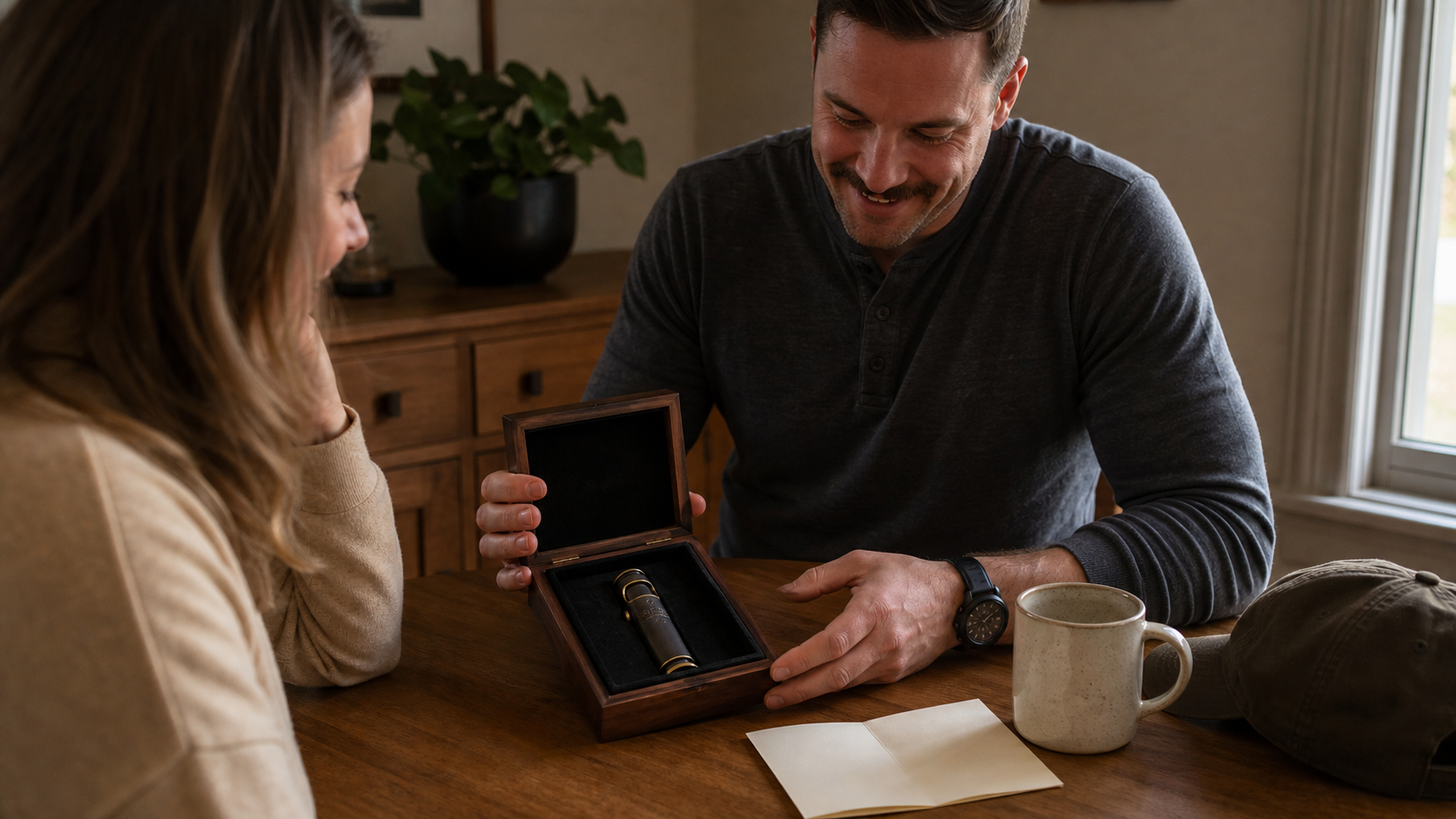
The Battle-Worn lighter is not made unique by calling it a veteran gift. It earns a place only when four facts align: the adult recipient already uses or collects lighters; they prefer a rough, visibly marked aged-brass surface; they want one accurate personal or service detail preserved; and the exact shipping, carrying, venue, fuel and storage path is allowed.
The current Large model measures 92 × 21.5 mm and weighs about 130 g. Its individually worked finish uses cracked lines, impact-style marks, darkened zones and exposed aged brass. Because each finish is completed by hand, surface breaks vary. The large engraving field can be reviewed for names, dates, service years, a short message, a symbol or clean authorized line art. WEDO ships the lighter without fuel.
Choose this surface only when the recipient wants what it means
A marked finish should correspond to the veteran’s taste—not to a giver’s assumption that every service story should look rough.

Large Battle-Worn Commemorative Edition
The verified Large form is 92 × 21.5 mm and approximately 130 g. Its individually finished surface uses cracked lines, impact-style marks, darkened areas and exposed aged brass; a name, date, service years, short message, symbol or clean approved line artwork can be reviewed for the available engraving field.
Best for: An adult user or collector who already wants a substantial lighter, prefers a deliberately marked finish, and has approved one accurate personal or service detail.
Check the Battle-Worn fit and engraving fieldChoose another gift if the veteran does not use lighters, prefers a clean or restrained surface, does not want service displayed, or faces an uncertain route. You can compare broader, non-default directions in the WEDO military collection, but the same recipient-first test still applies.
Transport and mailing rules can change. Check the current carrier and route. TSA and FAA resources distinguish lighter type, fuel status and transport method; an empty lighter is not universal permission for every trip or destination.
The final eight-question check
- Would this exact veteran choose the function or experience?
- Does it fit life now, not only a past title?
- Is the occasion accurate?
- Is service-related personalization genuinely welcome?
- Can every permanent name, date, unit, rank, location and symbol be verified?
- Do you have permission to use and display the story, photo or artwork?
- Can the recipient actually use, carry, receive, maintain and store the item?
- If every generic military symbol disappeared, would the gift still make sense?
If the final answer is no, return to the veteran’s present-day choices. That is where the unique part usually begins.
Frequently asked questions about unique gifts for veterans
What makes a gift for a veteran genuinely unique?
A unique veteran gift could not be given to another veteran unchanged. It reflects this person’s life now, one story or service detail they have approved, your relationship, and the actual occasion. The product category may be common; the verified combination is not. If the meaning depends only on a branch emblem or the word “veteran,” it is themed, not yet personal.
How can I ask what a veteran wants without ruining the surprise?
Ask for a direction rather than the exact item: “Would you rather use something, do something together, preserve a story, or get help with a project?” Then ask one boundary question: “Is service-related personalization welcome, or would you rather keep it about life now?” You can keep the object, color, maker, timing, card and presentation as the surprise.
Should I put a veteran’s rank, unit, medals or service years on the gift?
Only when the veteran wants that detail shown and the exact wording is verified. Confirm spelling, abbreviations, dates and the approved artwork version. VA and National Archives guidance explains that official records can verify assignments, awards and separation information, but access rules apply. Do not guess combat history or copy an insignia from an image search.
What if the veteran does not want a military-themed gift?
Believe them and remove the theme. Choose around the person’s current craft, family role, work, travel, home routine, health-neutral comfort, shared time or practical need. A veteran is not required to display service identity in order to be respected. A meal, finished household project, useful upgrade, printed family photos or no object at all can be the more accurate gift.
What is a thoughtful gift for an older veteran?
Start with access, comfort and consent rather than age stereotypes. Ask whether help with photographs, a familiar meal, transportation, a home task, a simple visit or an easy-to-handle keepsake would be welcome. Avoid forcing a recorded interview, surprise ceremony or heavy display piece. If preserving a story, let the veteran choose the subject, stop point, audience and final wording.
What should I engrave on a unique veteran gift?
Use a three-part limit: the name they use, one verified record such as a date or service span, and one short line they recognize. Often two of the three are enough. Put the longer story in a card or folio. Avoid guessed dates, operational details, copied trademarks, medical assumptions and slogans that could belong to any recipient.
Is the WEDO Large Battle-Worn lighter a good veteran gift?
It can fit an adult who already uses, maintains or collects lighters, explicitly likes a rough aged-brass surface, and wants a permanent service or personal detail engraved. It is not a default veteran gift. It is a poor choice for a non-user, someone who prefers a clean finish, an uncertain shipping or carry route, or a person who does not want service made visible.
Can a lighter be mailed or carried as a gift?
Rules depend on lighter type, fuel status, carrier, route, destination and method of transport. Check current carrier and travel guidance for the exact trip or address on the day you act. WEDO ships lighters without fuel, but an empty lighter is not a universal permission to mail, fly with, carry or store it everywhere.


コメントを書く
このサイトはhCaptchaによって保護されており、hCaptchaプライバシーポリシーおよび利用規約が適用されます。