
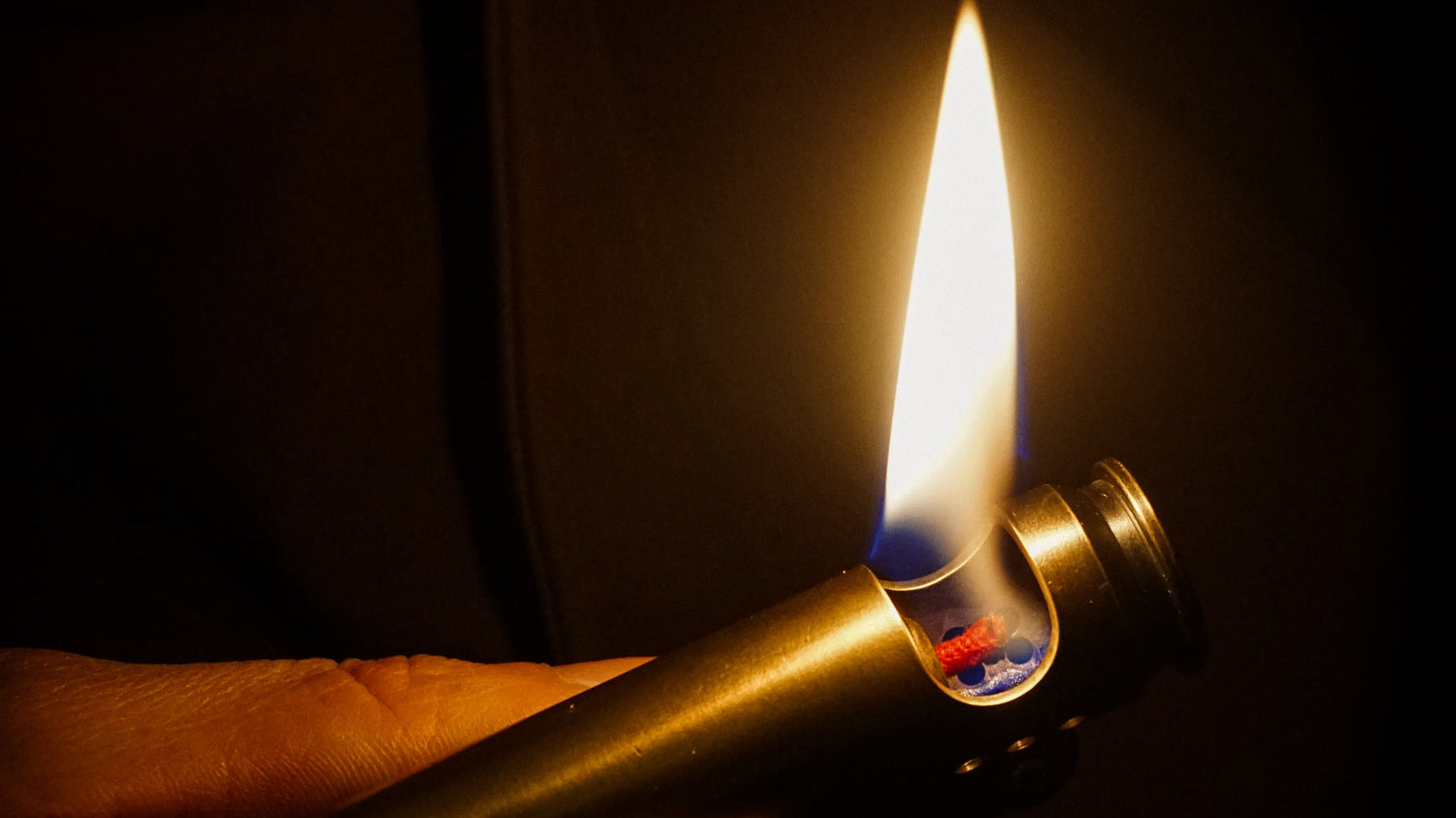
Lighter fluid is not one universal chemical. Wick-lighter fluid is usually a volatile mixture of low-boiling petroleum hydrocarbons commonly described as naphtha. Gas lighters use liquefied butane, sometimes in blends that may include isobutane or propane. Charcoal starter is a separate, heavier hydrocarbon product made for charcoal. The correct choice is the exact fuel named for the lighter’s mechanism; these products are not automatically interchangeable.
When people ask what is lighter fluid made of, they often expect one molecule. The useful answer is a product map. The familiar liquid poured into an absorbent wick lighter is usually a petroleum-derived hydrocarbon mixture. The gas injected through a refill valve is usually butane-based. The liquid sold to start charcoal belongs to a third product category. Each can burn, but combustion alone does not make one suitable for another device.
This distinction matters because the chemistry controls how the fuel is stored, delivered, vaporized, and ignited. It also prevents a dangerous shortcut: choosing a substitute by odor, appearance, or the word “fuel.” Start with the mechanism and the exact maker label, then use chemistry to understand why that instruction exists.
“Lighter fluid” is an umbrella phrase, not one formula
| Common product | Useful chemistry description | Delivery system | Intended use |
|---|---|---|---|
| Liquid pocket-lighter fuel | Volatile low-boiling petroleum hydrocarbons, commonly described as naphtha | Liquid held in absorbent packing and fed to a wick | Compatible liquid-fuel wick lighter |
| Butane refill fuel | Liquefied butane; some products may use hydrocarbon blends | Pressurized can, refill valve, internal tank, metering valve | Compatible refillable gas lighter |
| Charcoal starter fluid | A separate petroleum-hydrocarbon product with a different use profile | Poured onto unlit charcoal exactly as its label directs | Charcoal, not a pocket-lighter reservoir |
That table is a category guide, not permission to choose by a generic name. Product formulas, disclosed ranges, additives, vapor pressure, packaging, and regulations can change by brand and market. The exact current label and safety data sheet remain controlling. For the separate device-matching decision, use the lighter-fluid compatibility guide.
Liquid wick-lighter fuel: a naphtha-style mixture
Liquid lighter fluid ingredients are better described as a range of related hydrocarbons than as one pure chemical. Naphtha is a broad petroleum-mixture term. It can contain multiple low-molecular-weight hydrocarbon components whose combined volatility lets liquid move through absorbent packing, reach a wick, form vapor above the wick, and ignite. A product SDS normally identifies hazardous components or categories and concentration ranges required for safety communication; it may not publish every ingredient in a proprietary finished formula.
What is Zippo lighter fluid made of?
The current Zippo lighter-fluid SDS describes a mixture of low-boiling hydrotreated petroleum distillates associated with naphtha, including a predominant carbon range around C6–C9 in one disclosed entry. That supports the practical description “volatile petroleum-hydrocarbon mixture.” It does not justify rewriting the SDS ranges as an exact recipe, treating the product as a single molecule, or assuming every other brand has the same naphtha lighter fluid composition.
If you are asking what hydrocarbons are in lighter fluid, check the exact SDS revision for the product in your hand. Look for chemical identity, CAS numbers, concentration ranges, flash-point and vapor information, exposure controls, storage conditions, and incompatible materials. Do not combine ingredient lines from different brands to create a formula that no manufacturer published.

The absorbent packing explains why this fuel is a liquid at ordinary handling conditions. It stores liquid below the wick, while capillary action supplies a limited amount upward. The flame burns vapor near the wick rather than consuming a free pool of liquid. Packing condition, wick routing, seal condition, fill quantity, and the maker-specified fuel all affect performance.
Butane is a gas-system fuel, not liquid wick fluid
Is lighter fluid the same as butane?
No. In ordinary pocket-lighter language, “lighter fluid” often means the naphtha-style liquid used in an absorbent wick system. Butane is C4H10, a gas at ordinary atmospheric conditions that can be stored as a liquid under pressure. A refill can sends it through a matched nozzle and valve into a pressure-rated tank. The lighter then meters gas to a burner. The container, interface, and mechanism are fundamentally different.
The butane lighter fuel ingredients shown on a specific can or SDS may identify n-butane and, depending on the product, related gases such as isobutane or propane. Do not assume a blend, purity claim, pressure, or adapter from a different product. The practical difference between naphtha and butane lighter fuel is not merely a chemistry label: one is handled as a volatile liquid in absorbent packing, while the other is stored under pressure and released through valves.
| Feature | Naphtha-style wick fuel | Butane lighter fuel |
|---|---|---|
| State during refill | Free-flowing liquid | Liquefied gas under pressure |
| Lighter storage | Absorbent cotton or packing | Sealed pressure tank |
| Fuel delivery | Capillary action through a wick | Metering valve to a burner or jet |
| Refill interface | Maker-specified opening and packing | Compatible valve/nozzle or approved adapter |
| Wrong-fuel result | Contamination, leakage, abnormal flame, or damage | Failed fill, leak, seal damage, abnormal pressure, or fire risk |
Do not pour liquid wick fuel into a gas valve, and do not inject butane into absorbent packing. Once the correct category is confirmed, follow how to refill a lighter safely and the exact model instructions rather than transferring a procedure between systems.
Charcoal starter belongs outside the pocket lighter
Charcoal starter may also be called lighter fluid in a store, but its label points to unlit charcoal, not a pocket-lighter fuel chamber. Its formulation and performance goals can differ from liquid wick fuel. Asking can you use charcoal lighter fluid in a lighter is therefore a compatibility question, not a test of whether both liquids burn. Unless the exact lighter manufacturer names that exact product, do not put it into a wick lighter or any refill valve.
The same rule applies in reverse: pocket-lighter fuel is not automatically an approved charcoal starter. Use each product only for its labeled purpose, with the container, dosing, waiting time, and ignition separation its maker specifies. Never add any fuel to burning or hot charcoal.
Read an SDS without turning it into a secret recipe
A safety data sheet answers safety questions; it is not always a complete bill of materials. Section 3 generally identifies hazardous ingredients and ranges. Other sections cover fire behavior, first aid, spill response, handling, storage, exposure protection, physical properties, stability, transport, and disposal. A range such as 65–100 percent in one disclosed component entry is not proof that a bottle contains one pure substance, and ranges from separate entries should not be added mechanically when classifications overlap.
Does lighter fluid contain benzene?
There is no responsible universal yes-or-no answer for every brand, date, and market. The phrase “naphtha” identifies a petroleum-mixture category; it does not by itself prove that benzene is present, absent, or present at a particular concentration. For does lighter fluid contain benzene, consult the exact current product SDS and manufacturer. Do not infer exposure limits from a forum, an old sheet, another country’s product, or a generic composition article.
This evidence hierarchy also helps when marketing language says “clean,” “premium,” or “high purity.” Those words do not replace chemical identity, compatible mechanism, valve fit, storage directions, or exposure controls. A product can be well refined and still be entirely wrong for a different lighter system.
Why volatility helps a lighter—and creates handling limits
Why does lighter fluid evaporate so quickly?
Naphtha-style lighter fuel contains light hydrocarbons that readily enter the vapor phase. That volatility is functional: vapor near the wick can mix with air and ignite. The same property means an open cap, damaged seal, hot surface, spill, or overfilled lighter can release vapor rapidly. In plain language, why does lighter fluid evaporate and why it lights are related questions.
Evaporation can cool a wet surface and make a recently filled lighter seem dry while flammable vapor remains nearby. Wipe spills only as the manufacturer directs, close and remove the fuel container, ventilate the area, and observe the stated waiting time before ignition. Never use a test flame to find a leak or speed evaporation.

The wick does not change the fuel into a different chemical. It meters liquid and presents surface area for vapor formation. A charred wick, compacted packing, poor seal, wrong fuel, or overfill can change flame height, smoke, odor, and reliability. Diagnose the mechanism instead of trying to correct every symptom with more fuel.
Petroleum origin does not make gasoline a substitute
Is lighter fluid gasoline? No. Both can be petroleum-derived hydrocarbon mixtures, but gasoline is formulated for engines and can contain a different volatility curve and additives. Shared origin does not establish device compatibility. Automotive gasoline, camping fuel, paint thinner, alcohol, kerosene, charcoal starter, and unidentified solvents should not be poured into a pocket lighter unless the exact manufacturer explicitly specifies the exact product—which ordinary lighter instructions do not.
Do not try to improve a substitute by filtering it, mixing it with approved fuel, leaving it open to evaporate, or using only a few drops. Those actions cannot verify composition and may spread vapor or contamination. If wrong or unknown fuel has entered a lighter, extinguish it, keep ignition sources away, and follow manufacturer or qualified-service instructions. For old containers, use the separate guide to does lighter fluid expire rather than guessing from remaining volume.
Choose fuel by mechanism, label, and interface
- Identify the system: Look for a wick and absorbent packing, a gas refill valve and pressure tank, an electric charging port, or an unknown mechanism.
- Read the exact instructions: Use the maker-named fuel and current label for that model and market.
- Match the interface: A butane nozzle or adapter must be approved for the valve; a wick lighter must have the correct fill access and packing.
- Check the container: Keep the original label and closure. Reject leaks, corrosion, damage, missing identity, contamination, or prohibited heat exposure.
- Stop when uncertain: An electric lighter needs no fuel. An unknown mechanism also receives no fuel until identified.
The short answer to which lighter fluid should I use is: the exact product named for the verified mechanism. Chemistry explains the choice, but it does not override the manual. Current WEDO owners should use the WEDO Usage & Care instructions for their exact model.
One verified liquid-fuel wick example

Liquid-fuel wick system · 82 × 20 mm · About 105 g
Medium Classic
A current WEDO wick lighter made from a real repurposed .50 BMG brass casing. The verified record lists 82 × 20 mm, approximately 105 g, and replaceable wheel, flint, wick, lighter cotton, O-ring, springs and chain. It ships without fuel and requires standard lighter fluid before first use.
Best fit: An adult who has identified a liquid-fuel wick mechanism and accepts recurring fuel, flint, wick, cotton, seal, and cleaning maintenance. It is not a butane, charcoal-starter, gasoline, or unknown-fuel solution.
Check the current mechanism, dimensions, and included partsThis example appears only after the neutral chemistry and mechanism decision. Its true product photograph is not a generic illustration, and the card does not make another fuel compatible. Review the current Medium Classic mechanism and parts before choosing the wick-fuel branch.
Frequently Asked Questions
Can you use charcoal lighter fluid in a pocket lighter?
No, unless the exact lighter maker explicitly names that exact product—which ordinary pocket-lighter instructions do not. Charcoal starter is formulated and packaged for starting charcoal, not for an absorbent wick reservoir or a pressurized refill valve. Its different volatility, residue, dosing, and intended use can create poor performance, contamination, and serious fire or exposure risk. Do not experiment with a small amount.
Which lighter fluid should I use for my lighter?
Identify the mechanism before buying fuel. An absorbent-packed wick lighter normally uses the liquid fuel named by its maker. A refillable gas lighter uses the specified butane can and compatible valve or adapter. An electric arc lighter uses no fuel. If the mechanism, label, nozzle, valve, or model cannot be verified, use no fuel and ask the manufacturer or a qualified service source.
Is lighter fluid gasoline?
No. Both may be petroleum-derived hydrocarbon mixtures, but a shared origin does not make them the same product. Gasoline is blended for engines and may contain additives and a volatility profile that a pocket lighter was not designed to handle. Never use automotive gasoline as a substitute for labeled pocket-lighter fuel.
Is purified butane better for every lighter?
No. Purity does not change the mechanism. A high-purity butane can is still wrong for a liquid-fuel wick lighter, an electric lighter, or a gas lighter with an incompatible valve. For a butane lighter, follow the exact maker’s fuel, nozzle, pressure, and servicing directions.
Primary sources and evidence limits
- Zippo Lighter Fluid Safety Data Sheet for disclosed petroleum-distillate identities, hazards, handling, and storage.
- Zippo butane insert instructions for the separate pressurized refill path and compatible valve use.
- PubChem Butane for C4H10 identity and pressure-dependent physical state.
- PubChem Naphtha for the petroleum-mixture category.
- CPSC fuel-container safety and Poison Control hydrocarbon guidance for handling and exposure boundaries.
- A peer-reviewed commercial lighter-fluid study for evidence that brands can be varied hydrocarbon blends.
These sources support a category-level explanation. They do not reveal every proprietary ingredient, certify an old or transferred container, or replace the current label, SDS, manufacturer instructions, local rules, or professional exposure advice.
Composition-to-compatibility checklist
- Treat “lighter fluid” as an umbrella phrase until the product and mechanism are identified.
- Use naphtha-style liquid only in a maker-approved absorbent wick system.
- Use the specified butane product and compatible interface only in a maker-approved gas system.
- Keep charcoal starter, gasoline, solvents, alcohol, camping fuels, and unidentified liquids out of pocket lighters.
- Read the exact current SDS; do not turn hazard ranges into a secret recipe.
- Do not infer benzene or another constituent from the word naphtha alone.
- Respect volatility: close the container, control spills, ventilate, and keep ignition and heat away.
- When mechanism, product identity, or interface is uncertain, add no fuel.
The mechanism is the final compatibility gate. A fuel’s ability to burn does not prove that its chemistry, pressure, volatility, residue, container, or refill interface belongs in a particular lighter.


댓글 남기기
이 사이트는 hCaptcha에 의해 보호되며, hCaptcha의 개인 정보 보호 정책 과 서비스 약관 이 적용됩니다.