
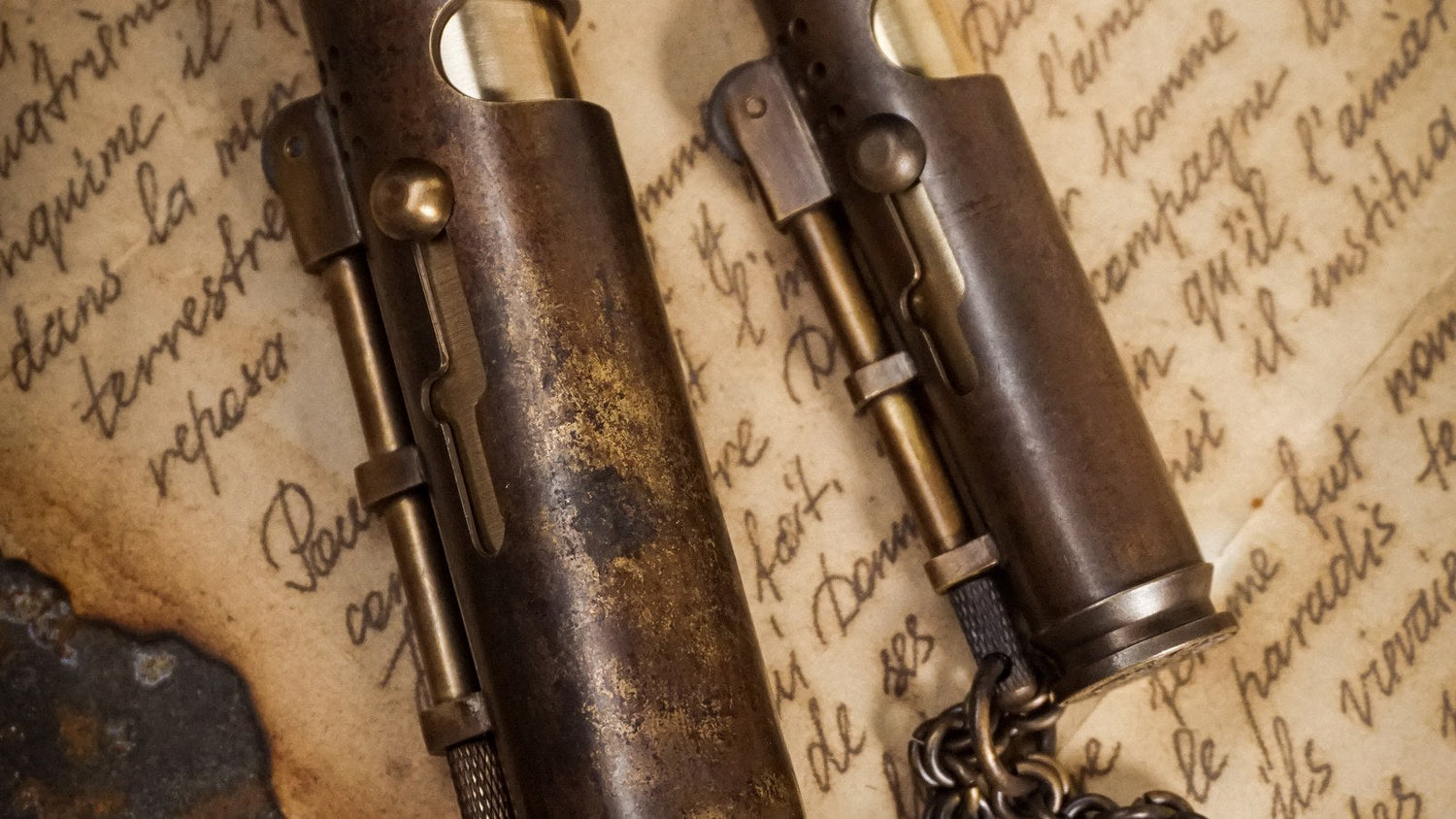
World War Two lighters included factory-made pocket lighters, ember-producing rope lighters, and individually made trench-art pieces. They were not one universal military-issue design. To identify an example, separate its manufacture date, documented wartime ownership, and mechanical construction. A brass case, dark finish, military engraving, or old-looking surface is not enough to establish a 1939–1945 origin. Museum records and traceable provenance provide stronger evidence than a seller’s wartime label.
Start with three separate questions
A dark metal lighter can look convincing in a photograph and still tell you very little about its age. Before evaluating a seller’s story, ask when the object was made, whether wartime use is documented, and how it actually creates ignition. Those questions overlap, but they are not interchangeable.
A prewar lighter could have been carried through the war. A newly made lighter can copy a wartime design. An old cartridge case can become part of a much later object. Even an authentic period case may contain replaced working parts. Keep those possibilities open until the evidence narrows them.
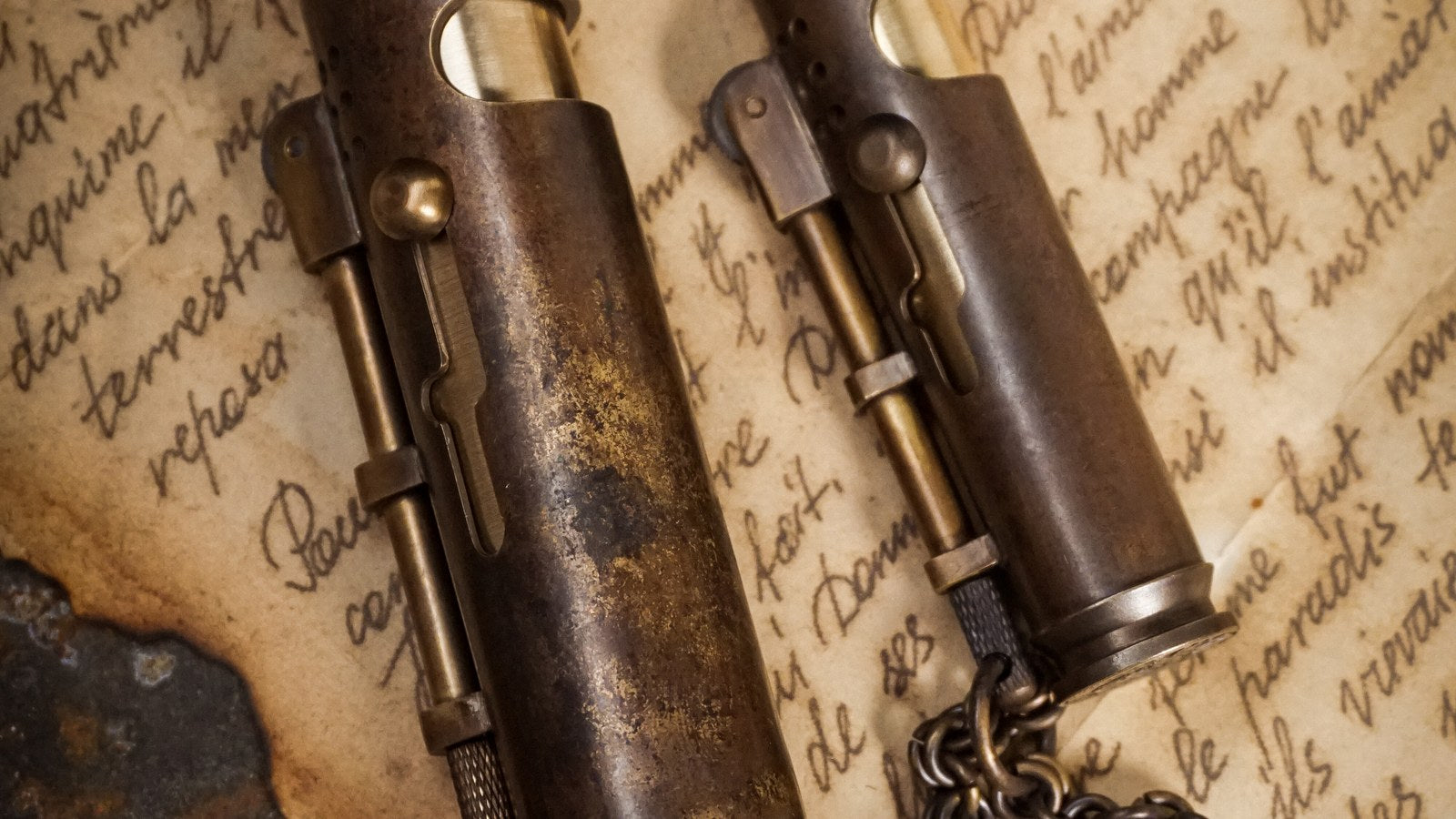
The opening photograph shows modern WEDO aged-brass pieces, not authenticated wartime artifacts. That distinction is intentional: appearance can introduce a question, but it cannot answer it.

Three documented kinds, not one universal design
What kinds of lighters were used in World War Two?
Documented examples include factory-made flame lighters, rope devices that produce an ember, and individually made trench-art lighters. These are useful starting categories, not a complete inventory of every army’s equipment. Within each category, manufacture, ownership and later alteration still require separate research.
Factory-made pocket lighters
Wartime pocket lighters included commercially developed designs. Zippo’s own history dates its first pocket lighter to 1933. It records a wartime shift to steel cases with a black crackle finish and production directed to the US military after American entry into the war. Steel black crackle lighters therefore provide one well-documented material example—not a rule that every wartime lighter was brass.
That chronology also makes a useful distinction: a brand’s founding date, a model’s introduction and the manufacture date of the object in your hand can all differ. For the broader sequence, see the lighter invention timeline.
Rope lighters produced an ember
The Australian War Memorial’s REL/11646 record describes an iron-and-cotton Greek rope lighter, made before 1941 and given to Captain Bruce Brock in Greece in April 1941. Its rope held an ember rather than producing a liquid-fuel flame. The dated gift supplies wartime context even though manufacture predates it.
Wartime rope lighters should not be treated as ordinary liquid-fuel wick lighters just because both contain fibrous material. This example establishes one documented object and association; it does not establish how widely every force used the design.
A cartridge case is a material clue, not a date
Does a cartridge case prove that a lighter was made during WWII?
No. The date of a component does not automatically date its conversion into a lighter. Cartridge case trench art lighters need object-specific evidence about who made them, where and when. A headstamp may inform research into the casing; it cannot, by itself, establish when the ignition mechanism was assembled.
A useful counterexample is Australian War Memorial REL34906, attributed to Neville Cropton Williams and dated approximately 1944 in Australia. The museum identifies the materials as Bakelite and cupronickel and describes a cartridge-case lighter on a stand. Its catalog supplies a maker, approximate date and service association instead of relying on aged appearance.
Notice both the strength and the limit: “approximately” is not an exact production day. “Trench art” does not automatically mean a piece was made inside a front-line trench, and the materials are not automatically brass. Retain the catalog’s qualifications when describing the object.
An evidence checklist for originals and replicas
How can I tell whether a WWII lighter is original or a reproduction?
Cross-check the complete construction, reliable maker chronology and traceable ownership history. No single test authenticates all original WWII lighters. WWII lighter replicas may copy a recognizable silhouette or finish while being honestly sold as new. The problem is not reproduction itself; it is describing one as a documented original.
For WWII lighter identification, request clear photographs of every accessible side, the base, markings and visible mechanism without asking anyone to force it apart. Ask what has been repaired or replaced. A case and insert that no longer match deserve explanation, not an automatic verdict either way.
| Evidence | What it can support | What it cannot prove alone |
|---|---|---|
| Dated maker record or catalog | A model or feature existed at a stated time | This particular object was made then |
| Construction and markings | Consistency with a documented maker or period | That all parts are original or an inscription is contemporary |
| Dated ownership records | A specific association when the object can be matched | Every later story attached to the object |
| Patina, paint or wear | Clues to material and condition | A precise age or military issue |
WWII lighter markings must be interpreted within the maker’s system. Zippo says its bottom date coding began in the mid-1950s. A missing modern date code is therefore not, by itself, proof of wartime manufacture; a plausible old stamp still needs supporting construction and provenance.
The Smithsonian advertising collection NMAH.AC.0094 spans 1937–1998 and includes advertisements and brochures. It offers a route to dated research, not a ready-made certificate for a seller’s lighter. Archive coverage, model chronology and individual authenticity are different levels of evidence.
Military issue, personal purchase or a gift?
Were all lighters carried by soldiers military-issued?
No. A lighter associated with a serviceman could have been purchased, received as a gift or obtained through a supply channel. “Carried during the war” and “officially issued” are different claims. Evidence for one should not quietly become evidence for the other.
The National WWII Museum’s account of Ernie Pyle and Reed Switzer describes a personal gift connected with wartime correspondence. It illustrates why an ownership story matters. It does not establish universal issue, and the museum’s open questions about a particular gift batch should remain questions.
For wartime lighter provenance, preserve the chain connecting the object to the account: a dated photograph showing distinctive features, a letter identifying the gift, an accession record, or a documented transfer. A family recollection can be a valuable lead. Label it as recollection until corroborated, and keep private family records out of public sales copy without permission.
Before buying: ask for evidence you can keep
Start by deciding whether you want a historical object, a design reproduction or a usable modern lighter. These can all be legitimate purchases, but their evidence requirements differ. A replica need not have wartime provenance; a listing priced around a wartime attribution should explain that attribution.
- Ask for the proposed maker and date range, with the reference used.
- Separate observed features from seller interpretation.
- Request disclosure of replacement inserts, repairs, refinishing and added decoration.
- Keep the listing, photographs and the seller’s written answers together.
- Check the return terms before paying for an attribution you cannot verify.
A vague “found in Europe” story is not equivalent to a documented ownership chain. Conversely, incomplete provenance does not automatically mean a fake. It means the claim should stay limited and the purchase should reflect that uncertainty. Our collectible lighter evaluation guide expands on design, condition and collecting priorities.
Preserve the evidence before changing the object
Preserving wartime lighters begins with documenting them, not making them shine. Photograph marks and surfaces before intervention. The Canadian Conservation Institute explains that polishing is abrasive and that paints, waxes or lacquers may form part of an object’s history. An apparently untidy surface may deserve assessment before removal.
Do not use this general metal-care principle as permission to apply solvents, heat or polish to a fuel-bearing mechanism. A significant or unidentified object belongs with a suitable conservator or specialist first. Keep detached original parts and treatment records together when safe. For a known lighter being considered for service, consult the separate vintage lighter inspection and refill guide.
Historical fuel anecdotes are not modern instructions. Nor should an unfamiliar ammunition-shaped object be treated as a craft project: do not drill, heat, dismantle or attempt to convert it. This article discusses finished museum objects, not how to manufacture them.
If you want aged brass rather than a wartime artifact
You do not need an original collectible to enjoy brass craftsmanship. A modern product can offer a known mechanism and documented specifications while leaving historically significant originals unaltered. For readers choosing that route, WEDO’s handmade brass shell lighters are contemporary products, not authenticated World War Two lighters.

Modern WEDO model · Not a WWII artifact
Medium Military (Antique)
A current wick lighter made from repurposed aged brass, measuring 82 × 20 mm and weighing approximately 105 g. The flint wheel, flint, wick, cotton, O-ring, springs and chain are replaceable. An accessory pack is included; fuel is not. Surface tone and marks vary between pieces.
Best for: An adult who wants aged brass and a known, serviceable modern mechanism. Not suitable as a substitute for an authenticated wartime collectible or as evidence of military issue.
See the modern Antique model and specificationsFrequently asked questions
How much is an original WWII lighter worth?
There is no reliable single price for the category. WWII lighter value depends on the identified maker and period, originality, condition, completeness and documented association. Compare completed sales of genuinely comparable objects, not a mixture of replicas and rare attributed pieces. An asking price is not a sale. Obtain specialist appraisal for a significant named or documented example.
Can I refill and use a lighter found with wartime belongings?
Do not add fuel just because the object was stored with wartime belongings. Identify the mechanism and assess its condition and historical significance first. Do not force seized parts or experiment with unknown liquids. If fuel remains, there is an odor or the object might be ammunition rather than a finished lighter, stop handling it and seek appropriate specialist assistance. This is an identification guide, not a refill procedure.
Does a date engraved on the case prove wartime manufacture?
No. An inscription can commemorate an earlier event or be added later. Record it accurately and look for a dated photograph, letter, maker record or documented ownership history that independently connects the marking to the object. Do not erase an uncertain inscription simply because its story has not yet been established.
Sources and the limits of this guide
This guide uses maker chronology, museum accession records and conservation guidance. It does not authenticate an individual object from a photograph, certify military issue or establish a sale price. Follow the linked records for their exact wording and qualifications.
- Zippo: The History of Zippo
- Australian War Memorial: REL/11646
- Australian War Memorial: REL34906
- National WWII Museum: The Words of War
- Smithsonian: NMAH.AC.0094
- Canadian Conservation Institute: Brass and Copper
The practical conclusion is simple: identify the mechanism, investigate the date and document the association separately. When one remains unknown, keep that uncertainty visible rather than replacing it with a more attractive story.


댓글 남기기
이 사이트는 hCaptcha에 의해 보호되며, hCaptcha의 개인 정보 보호 정책 과 서비스 약관 이 적용됩니다.