
When were lighters invented? The first true lighter was Döbereiner's lamp in 1823, which ignited hydrogen over a platinum catalyst. The modern pocket lighter came later: ferrocerium delivered a reliable spark from 1903, Ronson sold the first practical pocket lighters from 1910, Zippo arrived in 1932, and butane fuel replaced naphtha in the 1950s.
Most people mean "the modern pocket lighter" when they ask when lighters were invented, and the honest answer is not one date but a stack of inventions that stretched across more than a century. This guide walks the real timeline, corrects the "flint" misunderstanding, and ends with the vintage lighter types a collector or buyer can still recognize today.
A one-glance timeline of lighter history
| Year | Milestone | Why it matters |
|---|---|---|
| 1505 | Löffelholz-Codex sketch | A wall-mounted wheellock lighter concept, centuries before pocket lighters |
| 1662 | Evliya Çelebi records Viennese lighters | Early evidence of a self-contained fire-starting box for soldiers |
| 1823 | Döbereiner's lamp | The first widely documented "lighter" — hydrogen over a platinum catalyst |
| 1903 | Ferrocerium patented | The spark-making "flint" that made pocket lighters practical |
| 1910 | Ronson Pist-O-Liter | The first commercially successful pocket lighter |
| 1914–1918 | WWI trench lighters | Soldiers built lighters from spent cartridge cases |
| 1932 | Zippo founded | The windproof hinged-lid lighter that defined the category |
| 1950s | Butane fuel switch | Butane and piezo ignition created cheap disposables |
Before the lighter: fire needed a match or a strike
For centuries, making fire meant a flint-and-steel striker, a tinderbox, or, after 1826, John Walker's friction match. A portable device that produced its own flame on demand did not exist. The 1505 Löffelholz-Codex in Nuremberg sketched a wall-mounted wheellock mechanism that could be triggered by opening a door, but it was a novelty, not a product anyone carried.
1823: Döbereiner's lamp, the first true lighter
Who actually invented the lighter, and when?
The first device that fits the modern definition of a lighter was built by German chemist Johann Wolfgang Döbereiner in 1823. His lamp reacted zinc with sulfuric acid inside a sealed vessel to release hydrogen gas; the gas flowed over a platinum sponge, which catalyzed it into a flame. It was reliable but large, fragile, and dangerous enough that it never left laboratories and wealthy homes, and it faded by the end of the 19th century.
The important lesson of Döbereiner's lamp is that "invention" and "useful product" are different things. The idea of a self-igniting portable flame existed from 1823 — what was missing was a spark source small and cheap enough to carry.
1903: ferrocerium, the spark that changed everything
Is the flint in a lighter real flint?
Modern lighters depend on a material almost everyone misnames. The "flint" in a lighter is actually ferrocerium, an iron-cerium alloy patented by Carl Auer von Welsbach in 1903. Scrape it with a hardened wheel and it throws a shower of sparks hot enough to light fuel. Ferrocerium is cheap, tiny, and reliable — the exact opposite of Döbereiner's platinum-and-hydrogen chemistry.
This single material is what let manufacturers shrink a lighter from a laboratory apparatus into a pocket. If you want to fix or replace the spark source in a wick lighter, you are replacing a ferrocerium flint, not a piece of stone.
1910–1926: Ronson turns the lighter into a product
Using ferrocerium, the Ronson company made the first commercially successful pocket lighters. The Pist-O-Liter appeared in 1910 and the Wonderlite in 1913, both naphtha-fueled permanent-match designs. Ronson's "Banjo" of 1926 introduced the one-hand automatic action we now take for granted — press to light, release to extinguish. By the late 1920s, lighters had split into manual, semi-automatic, and automatic types.
1914–1918: the trench lighter is born from a cartridge
Did soldiers really make lighters out of bullet casings?
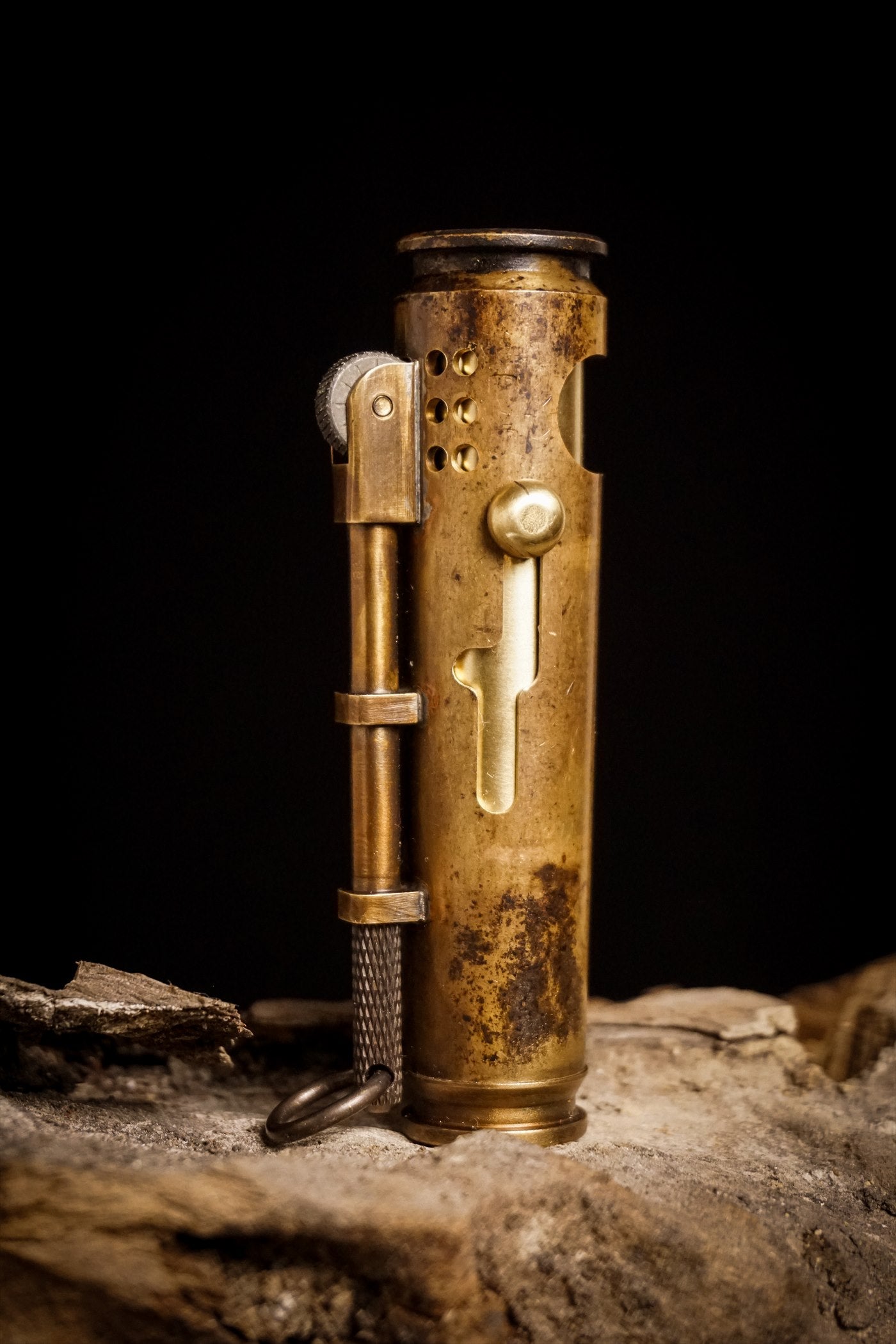
During the First World War, soldiers improvised lighters from spent brass cartridge cases, packing them with wick and fuel and adding a wind hood with air holes. The design worked so well that the trench lighter became a lasting category — and it is the direct ancestor of the repurposed cartridge-case lighters made today. A real trench lighter from the Battle of Verdun in 1916 survives as a museum piece, but the form lives on in modern brass wick lighters.
1932: Zippo and the hinged-lid standard
George Grant Blaisdell founded Zippo in 1932, and its hinged-lid, windproof, lifetime-warranty design became the reference for the whole category. Early Zippos burned naphtha through a wick; the design is so durable that countless vintage Zippos from the 1940s and 1950s still work today. The Zippo story matters to buyers because it fixed one expectation in the market: a quality lighter should be serviceable for decades, not thrown away.
1950s: butane and the rise of the disposable
Why did butane replace naphtha in lighters?
The switch from naphtha to butane in the 1950s changed everything. Butane burns with a controllable, nearly odorless flame, and its pressurization enabled the piezoelectric spark that replaced the flint wheel. The result was the cheap disposable butane lighter, and by the end of the 20th century most lighters were made in France, the United States, China, and Thailand. The trade-off was deliberate: a disposable is convenient and nearly free, but it is not meant to be serviced, which is why the repairable wick lighter never disappeared.
The vintage lighter types you can still recognize
If you are looking at a lighter and wondering which era it echoes, these are the categories that matter:
| Type | Fuel | What to look for |
|---|---|---|
| Wick lighter (naphtha) | Liquid fuel | A cloth wick, a removable flint, and an absorbent packing — the classic Zippo pattern |
| Trench / cartridge lighter | Liquid fuel | A body built from a spent brass casing, often with a wind hood |
| Brass pocket lighter | Butane or liquid | A machined brass body, the durable ancestor of today's metal lighters |
| Permanent match | Naphtha | A fuel-soaked wick stored inside a metal sheath, the Ronson Wonderlite idea |
What the history means for a modern buyer
The lighter's history is a story about one trade-off: serviceability versus convenience. Döbereiner's lamp was clever but unusable. The trench lighter was rough but repairable. The disposable butane lighter is convenient but meant to be thrown away. A quality modern lighter sits in the middle: it borrows the repairable wick-and-flint architecture of the 1930s and pairs it with today's materials and safety standards.
Collector's tip: when you see "vintage lighter" for sale, the honest question is not the age alone but whether it is a genuine period piece or a modern reproduction. Genuine antiques are usually marked, show honest wear, and use the fuel and flint system of their era; reproductions borrow the look but use current parts. Neither is "better" — the reproduction is simply the one you can still fuel, flint, and carry without worrying about a collector's piece.
Dates alone do not tell you whether a lighter is worth buying. A genuine 1940s wick lighter usually shows a smooth, heavy brass or steel body, a maker's stamp, and a flint wheel that still turns with firm resistance. A reproduction, by contrast, may copy the silhouette but use a modern wheel, a laser-etched mark, or a butane insert instead of the original naphtha wick. Neither choice is wrong: the genuine piece is a historical object that may need conservation and should rarely leave the shelf, while the reproduction gives you the same shape and the same daily ritual without the worry.
The practical test is to decide which one you actually want. If you want a display piece with provenance, buy a documented genuine lighter and treat it as a collectible. If you want a working everyday lighter that carries the trench and brass-era look, buy a current serviceable lighter and keep it fueled, flinted, and ready. Both are honest ways to own the history; they just serve different parts of your life.
Frequently asked questions
Johann Wolfgang Döbereiner invented the Döbereiner's lamp in 1823, the first documented self-contained lighter. George Blaisdell founded Zippo in 1932, which is a separate, later milestone.
Döbereiner's lamp lit pipes and cigars from 1823, but the practical pocket cigarette lighter is usually dated to Ronson's Pist-O-Liter of 1910 and the flint-based designs that followed ferrocerium in 1903.
No. Lighter "flint" is ferrocerium, an iron-cerium alloy patented in 1903. Real flint is a rock; ferrocerium is the synthetic spark material that made pocket lighters possible.
Yes. Soldiers built "trench lighters" from spent cartridge cases, adding a wind hood with air holes. The form became a lasting category and is the ancestor of modern repurposed cartridge-case lighters.
Butane became the dominant fuel in the 1950s, bringing controllable flame and piezo ignition, which enabled cheap disposable lighters.
Many are. Zippo's hinged-lid, wick-and-flint design is highly serviceable, and vintage examples from the 1940s and 1950s often still work after replacing the flint and fuel.
The trench or cartridge lighter is the oldest form still made today, alongside the wick lighter. Modern versions use current materials and safety standards while keeping the repairable architecture.
Look for maker's marks, honest wear, and era-appropriate fuel and flint systems. Reproductions use current parts and usually show modern machining. Both are legitimate; the reproduction is simply the one you can carry and use.
Brass lighters that continue the line
If the history appeals to you, these are the current WEDO brass lighters that carry the wick-and-flint and repurposed-casing tradition forward. Each ships unfueled and uses replaceable parts, the same serviceable idea the trench lighter proved a century ago.

Large Classic
A current brass wick lighter made from a real repurposed .50 BMG casing, with replaceable wheel, flint, wick, cotton, O-ring, springs and chain. It ships without fuel.
Check the Large Classic
Medium Hammered
A hand-hammered brass lighter that echoes the pre-war machined-brass era, with a serviceable wick system and replaceable parts. Ships without fuel.
Check the Medium Hammered
Collector Size Classic
A larger brass lighter for the collector who wants the trench-lighter form at display scale, built on a real repurposed casing with replaceable parts.
Check the Collector Size ClassicSources and method
This timeline is reconstructed from the Wikipedia "Lighter" article (which cites the 1505 Löffelholz-Codex, Evliya Çelebi's 1662 Vienna account, Döbereiner 1823, von Welsbach 1903, Ronson 1910/1913, Zippo 1932, and the 1950s butane switch), and from History of Matches' "History of Lighters." Facts about WEDO products come from the verified product records. Dates were cross-checked across both sources; where they disagreed on minor points, the more specific primary-source dating was kept.

Efterlad en kommentar
Denne side er beskyttet af hCaptcha, og hCaptchas Politik om beskyttelse af persondata og Servicevilkår er gældende.